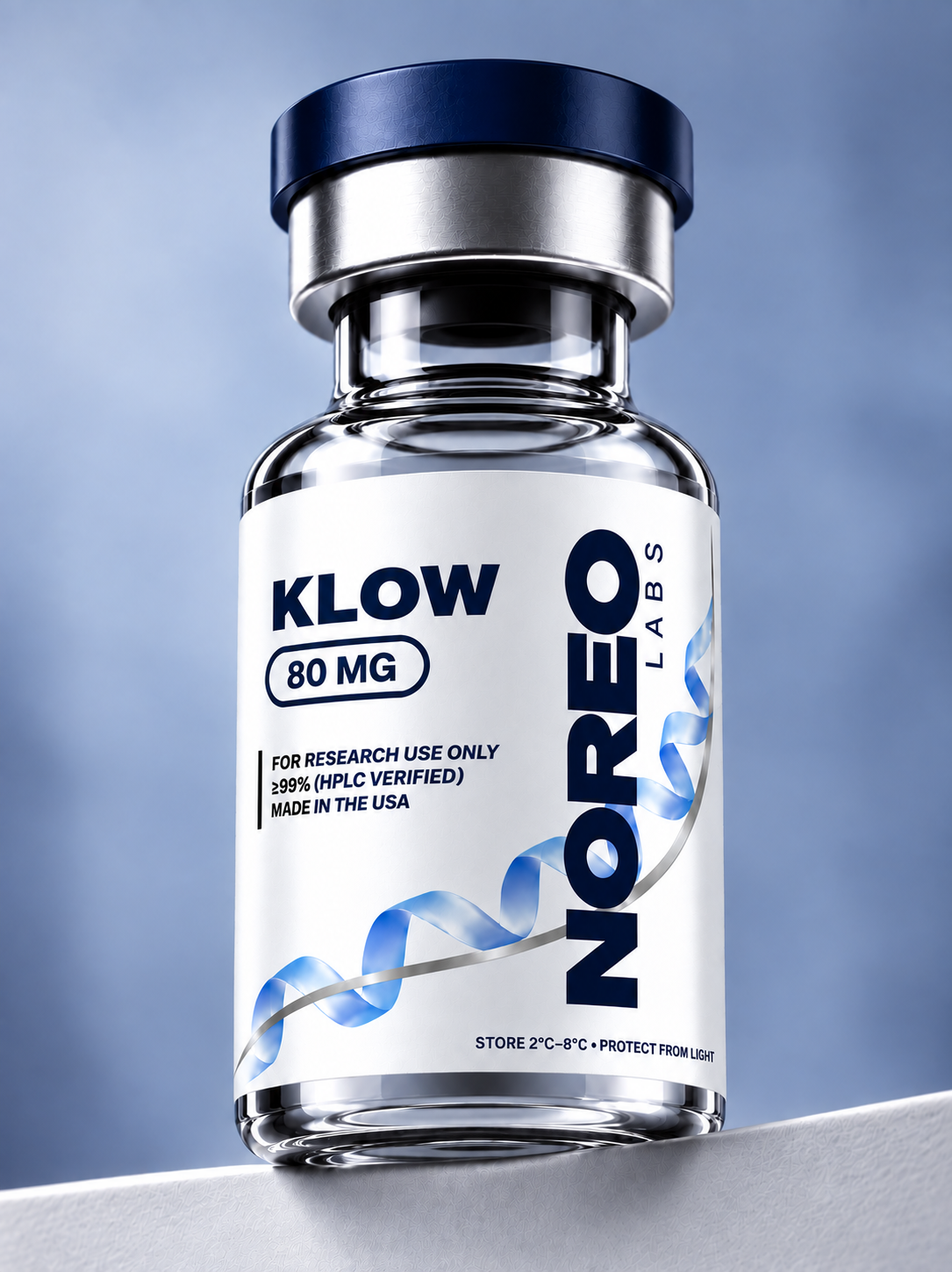
Klow Blend research peptide
$214.00
For research use only. Not for human or veterinary use.
NL-KLOW-80
BlendsKlow Blend research peptide
$214.00
CAD · institutional list · pricing provisional
- ≥98% by HPLC per component (lot-specific)
- Canada fulfilment
- ≥98% by HPLC per component (lot-specific)
- Canada fulfilment
Size
Order before 14:00 ET - ships next business day.
Third-party lab verified
Independently tested for identity and purity
- Batch
- KLW-081226
- Tested
- August 12, 2026
- Purity
- 99.4%
Tested by Testides
Klow Blend
$214.00
Product description
Klow Blend research peptide is supplied to qualified Canadian institutions as a characterized, co-lyophilized laboratory material for in vitro combination studies. The vial contains four independently specified peptides: KPV, GHK-Cu, BPC-157, and TB-500.
In vitro, the blend is used when an experimental design requires concurrent exposure to an α-MSH C-terminal tripeptide (KPV), a copper-coordinated Gly-His-Lys complex (GHK-Cu), a gastric-juice-derived pentadecapeptide (BPC-157), and the actin-binding heptapeptide motif of thymosin β4 (TB-500). Published component literatures describe NF-κB-pathway readouts for KPV, extracellular-matrix and copper-dependent gene-expression assays for GHK-Cu, VEGFR2-proximal endothelial assays for BPC-157, and G-actin sequestration assays for TB-500. Co-lyophilization removes an extra transfer step; it does not create a new, independently validated mechanism. Interpret combination data against single-component controls.
Mass loadings are fixed at manufacture (10 mg KPV + 50 mg GHK-Cu + 10 mg BPC-157 + 10 mg TB-500 per vial). The preparation contains a copper complex and should be kept desiccated at −20 °C, protected from light. PubChem identity is not assigned to the mixture as a whole; use per-component records and the lot COA.
Lots are sourced from a GMP-aligned peptide manufacturing partner. Each component is tested independently and reported at the stated HPLC purity (≥98% by HPLC per component, lot-specific) on the lot certificate of analysis (COA). Retain the COA with the inventory record.
This listing is a research-use-only peptide offered to qualified Canadian institutions for in vitro and laboratory use. Purchasing access is limited to verified Canadian research institutions; individual consumer accounts are not accepted. It is not for human or veterinary use, is not intended for diagnostic procedures, and has not been evaluated or authorized by Health Canada as a drug, diagnostic, or medical product.
Material specifications
Fields a receiving desk can paste into an order record.
- SKU
- NL-KLOW-80
- Pack
- 10 mg KPV + 50 mg GHK-Cu + 10 mg BPC-157 + 10 mg TB-500 per vial
- Purity
- ≥98% by HPLC per component (lot-specific)